Showing posts with label Save the Planet. Show all posts

Tuesday, January 25, 2011

Turn Plastic Back to Oil?

The BLEST company from Japan introduced a machine back in 2007 that they claim can revert waste plastic back to its oil form, without the use of flames or excessive gas emissions. The claim was revisited recently by Our World 2.0. Check out the excerpt below.

Though Japan has much improved its “effective utilization” rate over the years to 72% in 2006, that leaves 28% of plastic to be buried in landfills or burned. According to Plastic Waste Management Institute data, “effective utilization” includes not just the 20% that is actually recycled, but also 52% that is being incinerated for “energy recovery” purposes, i.e., generating heat or electric power.

“If we burn the plastic, we generate toxins and a large amount of CO2. If we convert it into oil, we save CO2 and at the same time increase people’s awareness about the value of plastic garbage,” says Akinori Ito, CEO of Blest.

Blest’s conversion technology is very safe because it uses a temperature controlling electric heater rather than flame. The machines are able to process polyethylene, polystyrene and polypropylene (numbers 2-4) but not PET bottles (number 1). The result is a crude gas that can fuel things like generators or stoves and, when refined, can even be pumped into a car, a boat or motorbike. One kilogram of plastic produces almost one liter of oil. To convert that amount takes about 1 kilowatt of electricity, which is approximately ¥20 or 20 cents’ worth.

Check out this You Tube Video

Tuesday, May 18, 2010

EMECO x COKE Recycled Plastic Chairs

In 2006 Coca-Cola approached Emeco, the aluminum chair company, to make a chair out of recycled PET material. Emeco jumped on the challenge and in April of 2010 have finally released their creation at the Milan Furniture Show. Working closely with petrochemical innovators BASF, they have formulated new materials to enhance the strength of rPET and create a new color palette to suite their product. In addition, substantial improvements were implemented on the mould design and manufacturing process to accommodate the recycled materials.

The result? 111 Navy Chair™, a plastic chair made from 111 (one hundred and eleven) plastic Coca-Cola bottles.


“The goal of the 111 Navy project was to alter consumer behavior by illustrating the value of rPET with beautifully designed and everyday products - ultimately encouraging more recycling.”


Source: NotCot, EMECO

Wednesday, April 14, 2010

PUMA x Eco Friendly Packaging

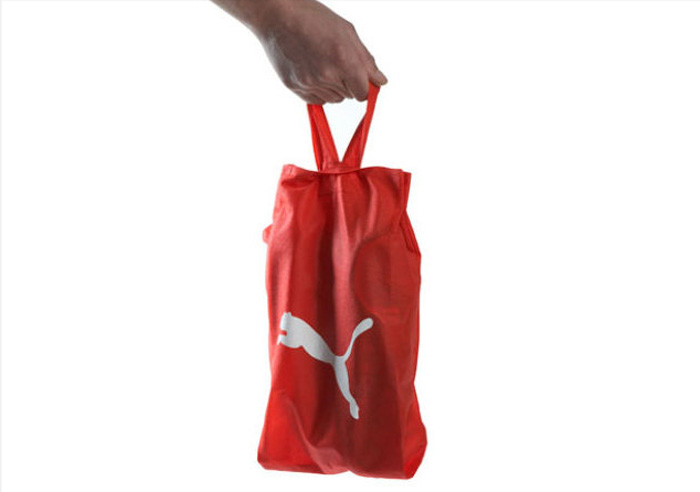
PUMA has recently introduced the 'Clever Little Bag' as a sustainable packaging substitute for the large boxes filled with paper that we are so used to buying sneakers in. Continuing their long-term commitment to social and environmental causes, this sustainable packaging and distribution system was designed by Yves Behar.

The new innovative solution will significantly reduce the amount of waste and CO2 emissions that traditional product packaging such as shoe-boxes and apparel polyethylene bags generate and underpins PUMA’s target of reducing carbon, energy, water, and waste by 25%, and developing 50% of its international product collections in footwear, apparel and accessories according to best practice sustainability standards by 2015.


Tuesday, April 13, 2010

321 Tap into Water

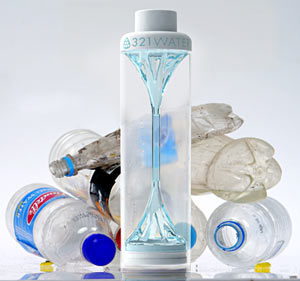
An Australian company called 'Half a Teaspoon' is dedicated to creating and introducing new products to to their market that would make it easier for consumers to make more environmental choices. Their latest product is the 321 Water Bottle that can instantly purify tap water with a plunger built into a portable bottle. Their website claims that one push will remove 'any chlorine, unpleasant tastes, and odors' from the water.


While the product design is interesting and the concept is commendable, I do not see this product surviving outside an urban environment. Firstly you would require access to fairly well treated tap water, and secondly it is just not as convenient as throwing a carton of bottled water into your car when you are heading out onto the road. Plastic waste is an issue we must contend with but new concepts must consider the function of the plastic bottle. Not only do plastic containers allow us to drink good quality water on demand, but also allow us to transport large quantities of drink water to locations where none is available.

Tuesday, March 30, 2010

PLASTIKI - A Boat Made of Recycled PET

A boat made using over 12,000 PET bottles has set sail on a voyage that will take them across the Pacific Ocean from the western coast of North America to the Eastern Coast of Australia. The mission is to raise awareness of environmental issues this planet faces and also address social issues whist driving innovative solution.


"It’s about recognizing that waste is fundamentally a design flaw (it does not appear in nature) It’s about re-thinking waste as a resource. It’s about cyclical ‘cradle-to-cradle’ philosophies rather than linear thinking when it comes to how we design our world. It’s about a better understanding of the lifecycle’s and materials used in our everyday lives. It’s about being curious and open, being prepared to let go of assumptions in order to undertake a new ‘Planet 2.0’ way of thinking and acting. It’s about acknowledging that we don’t have all the answers and that nobody is as smart as everybody. It’s about being collaborative and curious so to engage multiple perspectives, skills, opinions and organizations. It’s about constantly learning, unlearning and re-learning. It’s about re-integrating back into the web of life by recognizing and reducing our human fingerprints on the natural world. It’s about moving on from just articulating the problems and inspiring action of the solutions. It’s about encouraging the world to reduce, reuse, recycle and rethink more of the planets natural resources. It’s about delivering a spectacular global “Message in a Bottle”."


This is a landmark expedition that we hope paves the way for more adventurous entrepreneurs to give something back by opening the door to new possibilities. You can follow the voyages of the PLASTIKI on the their website. The voyage will take 3 months to complete and we wish them the best of luck.


Source: PLASTIKI

Thursday, February 18, 2010

Salve Water x Social Business


“I will not spend the money for myself. I will rather spend it in special business on a no-profit-no-loss policy.” – Muhammad Yunus

The quote from Professor Dr. Muhammad Yunus, a Nobel Prize laureate and the developer of the term “social business”, summarizes well the process which guided the concept behind Salve (”Save” in Portuguese), a product conceived and branded by À La Carte Design and developed in joint with Acqua Incorp.

We’re living in an era in which philanthropy, eco-consciousness and well-being are increasingly present in each aspect of our daily lives. And the “Generation G” – G for “generosity” –, as pointed out by Trendwatching website, moves and is moved by this urge in doing the good, not only for the self, but for everyone else. And is precisely in this desire to do the good that “Salve” makes a call, turning the simple act of buying a bottle of water into a collaborative movement that helps to transform lives.

The identity follows this concept, of collectiveness, compounded by a mosaic of icons representing positive attitudes which, albeit small, form a greater picture; the importance of small acts that realize great things together.

And to kick off this project, Instituto Criar will be the first institution to be benefited through the “Salve” water, with your donation. Take an action, take “Salve”.

Source: Lovely Package

Friday, January 15, 2010

Water for Water

“Recently finished design for a new line of bottled water called ‘Water For Water’ which is currently stocked across all Gloria Jean’s Coffee houses in Australia, with plans to implement the water into the international GJC franchises in the near future as well as other retail outlets.

The goal of the design was to reflect the international goals of the water (via the small text on the front with WATER in different languages) along with providing a design that would stand out from the rest of the bottled water that’s currently on the market. The design of the bottle took on and off approximately six months, going through various different design iterations including trials on different stocks, and was also affected by getting approval for the right launch date.

All of the profits from the sale of Water for Water go directly towards water based projects and initiatives and currently the first project is a Water Station in Caloocan, Philippines. It’ll provide not only clean drinking water at a minute cost, but also host a community centre that’ll he provide education both for children and adults as well as run programs on healthy living.”


Source: Lovely Package

Monday, January 11, 2010

Method Laudry Detergent

Method Laundry Detergent has just dropped their new fabric cleaner in the US market and claim that it is 'smarter', 'easier', and 'greener' than their competitors brands. How? Well they are utilizing a new formula with 'smartclean' technology, their precision dosing pump avoids wastage, and their plant based formula is 95% natural packed in bottles that are not only easier to hold and transport, but also uses 36% less plastic than other leading detergent brands. While it usually cost consumers more to go green, Method Laundry Detergent is actually giving visitors to their website $2 off of their next Method purchase. While USA and EU are offering subsidies to manufacturers who cut emissions in those regions, we still have to weigh how cost effective it is to 'go green' in Africa.


Sunday, January 10, 2010

Is Glass Packing Best for the Environment?

Beverage Daily today published an article titled 'Glass Packing is Best for the Environment'. While the article does contain some interesting facts, it is however based on a study conducted by the EU Association for Container Glass. 2 countries that have the most successful glass recycling systems in place are Belgium and Sweden with close to 100% of their glass jars and bottles that were put on the market, being collected for recycling.

Responsible beverage manufacturers do regularly ask the question, is glass better for the environment? Based on extensive studies, the answer is yes. But is it a practical solution for 3rd world or West African market place? The cost of manufacturing glass bottles is more expensive as is distribution. The recycling process is also costly and bottles have to be collected from various vendors. Transporting bottles to rural areas takes trucks over some rough roads which inevitably leads to breakages. Glass is also more heavy in areas where goods are transported over long distances by manual labor.

While both Sweden and France have some of the best drinking water available from their taps, they also boast the most sophisticated glass bottle and jar recycling systems. But in places like Africa where there is a greater demand for packaged food and beverages, there are few facilities to deal with the rubbish left over. It is still evident that the recycling technology available in the America's and Europe has not even begun to trickle down to Africa, while large beverage manufacturers can still take advantage of the loose carbon and waste emission laws. It seems to me that the question is not really weather PET or glass is better, but rather, what else have we got?

Friday, January 8, 2010

COCO Organic Coconut Water

“Brazilian scientist Dr Antonio Martins invented a revolutionary new way of extracting coco juice so that it is left as pure and untouched as it is in the coconut.

His brief to us was to craft a new identity that linked his coco juice, coco milks and indulgent coco cream, and to create packaging that also communicated the various health benefits and taste characteristics of the different products.

Our brand overhaul managed to pull off Dr Martins’ various demands and had a dramatic effect on sales, securing the brand an award at an international exhibition and a prestigious launch at Harvey Nichols.”


Green Coco Europe appears to have a great business model where they source only organic coconuts from local co-operatives. They also try to invest directly in education charities passing on Dr. Martins patented extraction technology. They got a pretty good assortment of products with mixed flavors including pineapple and banana. One of their goals is to expand their range using all parts of the coconut (water, flesh, and husk).

Wednesday, January 6, 2010

Recyled PET Bottle Dwellings

While PET beverage packaging is practical and cost effective, most manufacturers and consumers alike are aware of the environmental impact our addiction to PET has on this planet. While we can not eliminate the need for PET bottles, there are more solutions available to recycle PET.

Individual environmentalists and scientists have been working with impoverished communities in Latin America and Caribbean nations using waste PET bottles to build homes. They have demonstrated that by filling bottles with silted sand and with their method of construction, "PET bottles make a tougher, more durable construction material than common concrete blocks used in most Central American building."

PET bottles are either woven together and stacked with reinforcement to make walls or even poured in molds with cement to create modular panels.


Not only has this method proven to be practical and durable, some conversationalists are even making these homes look good!


With an island of PET the size of North America taking shape in the Pacific Ocean and our demand for packaged beverages on the rise, this is just another solution for 3rd world markets to consider.

Sources: Learning Site, Temasactuales, EcoPop


Tuesday, December 1, 2009

Vegetable Based PET by Coca-Cola

Coca-Cola has committed themselves to using 30% vegetable based PET preforms for their plastic bottle production. Is this a log term environmental solution that other beverage packaging companies can adopt? What is the cost benefit? Check out the full scoop below.

Coca-Cola Co yesterday announced the selective global roll-out of its new PET bottle made from up to 30 per cent plant materials such as sugar and molasses.

The drinks giant said its PlantBottle containers were beginning to hit retail shelves across the world, with a planned production target of two billion by the end of next year.

Hailing the move as a “major step along our sustainable packaging journey”, chairman and CEO Muhtar Kent said Coke was the first to bring to market a recyclable PET plastic bottle made partially from plants.

Variable plant content

But company said the level of plant material in the bottle differs from country to country.

“While the bio-based component can account for up to 30 percent of the resulting PET plastic in PlantBottle packaging, the percentage varies for bottles that also contain recycled PET,” said a Coke statement.

In Denmark, the bottle also has recycled content, meaning its combined plant-based and recycled elements make up 65 per cent of the material; 50 percent coming from recycled material and 15 percent from plant-based material. In the US and Canada, some 30 percent of the content in the PET plastic comes from plants.

The bottle is currently available in Denmark in 500ml and 2 litre sizes, with a December launch earmarked for Western Canada for Coca-Cola, Sprite Fresca and Dasani, as well as in Vancouver for next year’s Winter Olympic games. The PlantBottle will also be available in some parts of the western US from January 2010. Future launches next year are being planned in other markets, including Brazil, Japan and Mexico and China, said the company.

Sugar and Molasses

The bottle is currently made by turning sugar and molasses into a component in PET plastic. The company said its ultimate goal was to use non-food, plant-based waste, such as wood chips or wheat stalks, to produce recyclable PET plastic bottles. The container is 100 per cent recyclable and initial research has indicated it had a smaller carbon footprint than conventional PET bottles, said the company.

Kate Krebs, director of sustainable resources for the climate group, said: "While Coca-Cola is just beginning to bring its plant-based PET plastic into the mix, this is a revolutionary solution that has the potential for long-term, meaningful benefits."


Source: Beverage Daily

Wednesday, July 29, 2009

Help Remedies Biodegradable Packaging

Here at PAE we are always on the look out for environmentally freindly packaging. Help Remedies have come up with an awesome and simple design to conquer fears most people have of medicine. Personlly I hate looking through shelves of indistinguishable brands looking for tablets to suit my syptoms, and this packaging does not beat around the ush at all. Furthermore the packaging is made from paper pulp and corn based plastic that not only looks good but is also biodegradable.